A good driveway in Tanzania is built on a compacted gravel base 150 to 250 mm thick, shaped to drain water away, held in by firm edges, and finished with paving blocks, concrete or a sealed surface. Paving blocks are the most popular choice for homes because they look good, handle the heat and can be lifted for repairs. Concrete is best for heavy vehicles and steep slopes. Gravel is cheapest but needs topping up every year. Whatever the surface, the base and the drainage decide how long it lasts.
What should be under a driveway?
Every durable driveway has the same build-up, just in different thicknesses:
- Prepared ground: topsoil and roots removed, soft spots dug out, the soil compacted.
- Sub-base: selected gravel, 150 to 200 mm for cars, more for lorries or weak soil, compacted in layers.
- Base or bedding: crushed stone or a sand bed, depending on the surface.
- Surface: paving blocks, concrete, or gravel.
- Edges: kerbs or a concrete edge beam to stop the surface spreading.
On black cotton soil, the clay should be removed or treated first, or the driveway will heave and crack as the soil swells and shrinks. Our guide to road construction layers explains why each layer matters.
Which surface is best for a home driveway?
| Surface | Example installed cost per m² (2026) | Life | Good for | Watch out for |
|---|---|---|---|---|
| Gravel | TSh 20,000 to 40,000 (about USD 8 to 15) | Needs topping up yearly | Long rural drives, low budgets | Dust, ruts, washing away on slopes |
| Paving blocks (60 mm) | TSh 45,000 to 80,000 (about USD 17 to 31) | 20 years or more | Cars, homes, compounds | Weak edges, poor base |
| Paving blocks (80 mm) | TSh 55,000 to 95,000 (about USD 21 to 37) | 20 years or more | Delivery trucks, commercial sites | Same as above |
| Plain concrete (150 mm, mesh) | TSh 80,000 to 140,000 (about USD 31 to 54) | 25 years or more | Steep slopes, heavy vehicles | Cracking without joints, curing |
| Asphalt | Usually not practical for small areas | 15 years or more | Long estate roads | Needs plant and a contractor with a paver |
Example prices only, including base and labour on a normal site. Your price depends on soil, access, thickness and finish. USD figures are approximate at roughly TSh 2,600 per USD. Paving block supply prices in Dar es Salaam are often listed around TSh 25,000 to 30,000 per m² for the blocks alone.
How do you lay paving blocks properly?
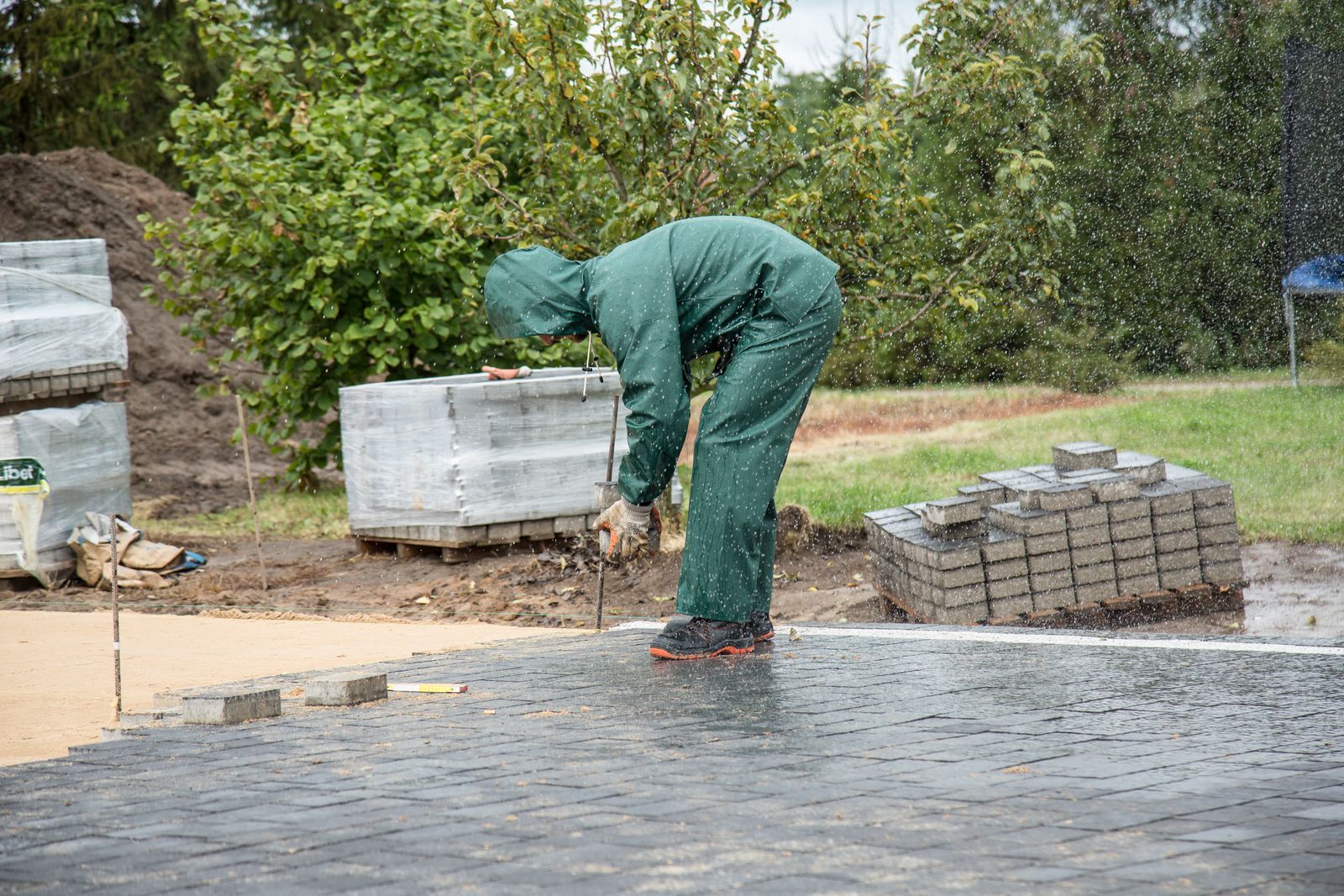
Paving blocks fail for predictable reasons, mostly a soft base or loose edges. The right sequence is:
- Excavate to the required depth and compact the ground.
- Lay and compact the sub-base in layers no thicker than 100 to 150 mm each.
- Build the edge restraints (kerbs or a concrete edge) before laying blocks.
- Spread a 30 to 50 mm bed of clean sharp sand and screed it level. Do not compact the sand before the blocks go down.
- Lay the blocks in the chosen pattern. Herringbone locks best for vehicles.
- Cut blocks to fit at the edges, then run a plate compactor over the surface.
- Brush fine dry sand into the joints and compact again until the joints are full.
When is concrete the better choice?
Concrete suits steep driveways, where blocks and gravel can slide or wash out, and areas that carry heavy vehicles. A typical home driveway slab is 125 to 150 mm thick, on a compacted base, with a steel mesh near the middle. Two details matter more than anything else:
- Joints: cut or formed every 3 to 4 metres to control where the concrete cracks. Without them it cracks anyway, just randomly.
- Curing: keep the concrete wet for at least seven days and keep vehicles off for longer. Our guide on curing concrete in hot weather explains why.
A brushed finish gives grip on slopes, which matters in the rainy season.
How should a driveway drain?
Water is the main enemy of any driveway. Build in:
- A fall of about 1.5 to 2 per cent so water runs off, away from the house.
- A channel or grated drain at the gate if the driveway slopes towards the road, or at the garage if it slopes towards the house.
- A culvert under the entrance where the driveway crosses a roadside drain. Blocking the public drain with fill is one of the most common causes of flooding on residential streets.
Our guide to culverts and road drainage explains how to size and build that crossing.
What are the most common driveway mistakes?
- Laying blocks straight on soil, or on a thin layer of sand over soil.
- No edge restraint, so blocks creep outwards and gaps open.
- Concrete poured with no joints and no curing.
- Driveway levels that send rainwater into the garage or towards the house walls.
- Filling the roadside drain instead of putting in a culvert.
- Planting large trees right beside the driveway, whose roots later lift the surface.
Frequently asked questions
How thick should a driveway base be?
For cars on firm soil, about 150 mm of compacted gravel sub-base under the surface. For lorries, soft soil or black cotton soil, 200 to 300 mm or more, and sometimes soil replacement first.
Are paving blocks better than concrete for a driveway?
For most homes, yes: they look good, are easier to repair and handle movement better. Concrete is better on steep slopes and where heavy vehicles turn often.
How long does it take to build a driveway?
A typical house driveway of 50 to 100 m² takes one to three weeks with paving blocks, and a little longer with concrete because of curing time.
Do I need permission to build a culvert at my gate?
Usually yes, because the roadside drain belongs to the road authority. Check with TARURA or your municipal council before you work in the road reserve.
Planning a driveway or compound paving?
Vika Construction lays driveways, compound paving and access roads with proper bases and drainage. See our civil works or contact us with your plot location.
Found this useful? Share it with someone who is building.